In our last issue, we explored what it takes to make smart glasses "smart" and why the intelligence behind them matters for frontline work.
Now consider what happens when a mistake isn't caught until after the work is done.
In equipment maintenance and repair, for example, a missed step, incorrect part, incomplete repair, or overlooked item can quickly become downtime, rework, a failed inspection, or another trip to the jobsite.
Frontline Intelligence brings AI-powered, hands-free support into the flow of work, helping workers access the right knowledge and guidance when they need it, with the opportunity to catch issues earlier.
This month's issue explores why moving intelligence closer to execution matters, and how it creates the foundation for detecting, correcting, and ultimately preventing mistakes in the moment.
In equipment maintenance and repair, a small mistake rarely stays small. A missed step, incorrect part, or incomplete repair can quickly become additional downtime, rework, or another trip to the jobsite.
Catch the issue while the work is happening, and the fix may be relatively simple. Catch it after the equipment is back in service, or the technician has left the site, and the cost and complexity can grow quickly.
Michael Manuccia, COO of Strivr, sees this through an operational lens. Quality, cost, productivity, and customer experience can all be affected by an execution issue that was relatively small when it started.
There is a solution to this challenge, and it's driven by bringing AI-powered knowledge and guidance into the flow of work. Frontline Intelligence understands what's happening, recognizes when work deviates from what's expected, and helps workers correct issues before they move downstream.
SIGNAL FROM THE FLOOR
AI is moving from generating answers to validating outcomes.
Siemens and NVIDIA recently announced self-verifying agentic AI workflows that can reason, act, and continuously validate decisions against trusted engineering tools.
Although the application is electronic design, the principle is worth noting. As AI takes on more complex work, knowing what should happen isn't enough. There also needs to be a way to determine whether the outcome is correct.
For frontline work, that progression starts with giving workers better access to the knowledge and guidance they need during execution. Over time, the opportunity gets bigger. AI that can understand what is happening, compare it to what should happen, and recognize when something needs attention.
This is the vision of Frontline Intelligence. It supports the work in the moment today while building toward intelligence that can ultimately help verify that the work was done right before it's too late.
AI is moving from generating answers to validating outcomes.
Siemens and NVIDIA recently announced self-verifying agentic AI workflows that can reason, act, and continuously validate decisions against trusted engineering tools.
Although the application is electronic design, the principle is worth noting. As AI takes on more complex work, knowing what should happen isn't enough. There also needs to be a way to determine whether the outcome is correct.
For frontline work, that progression starts with giving workers better access to the knowledge and guidance they need during execution. Over time, the opportunity gets bigger. AI that can understand what is happening, compare it to what should happen, and recognize when something needs attention.
This is the vision of Frontline Intelligence. It supports the work in the moment today while building toward intelligence that can ultimately help verify that the work was done right before it’s too late.
So where should operations leaders start with Frontline Intelligence?
Look for a critical workflow where catching an issue early is simple, but fixing it later is costly.
Ask:
Where do workers rely on memory, manuals, or experienced technicians for help?
Where can one missed step or wrong decision lead to downtime or rework?
Where could better guidance help workers get it right the first time?
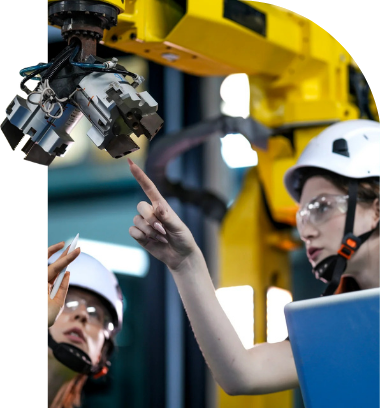
Equipment maintenance and repair is a strong example. Technicians make critical decisions while working hands-on with complex equipment, where getting the right information in the moment can mean the difference between resolving an issue and extending downtime.
Frontline Intelligence brings AI-powered knowledge and guidance hands-free into the flow of work, while building toward intelligence that can ultimately understand and verify the work itself.
In the Flow of Work
Start where mistakes get expensive
So where should operations leaders start with Frontline Intelligence?
Look for a critical workflow where catching an issue early is simple, but fixing it later is costly.
Ask:
Where do workers rely on memory, manuals, or experienced technicians for help?
Where can one missed step or wrong decision lead to downtime or rework?
Where could better guidance help workers get it right the first time?
Equipment maintenance and repair is a strong example. Technicians make critical decisions while working hands-on with complex equipment, where getting the right information in the moment can mean the difference between resolving an issue and extending downtime.
Frontline Intelligence brings AI-powered knowledge and guidance hands-free into the flow of work, while building toward intelligence that can ultimately understand and verify the work itself.
Worth Reading
From guidance to execution verification
What happens when AI moves beyond helping workers know what to do and begins to understand whether the work is being done correctly?
Our latest blog explores how Frontline Intelligence can evolve from delivering guidance in the flow of work to detecting missed steps and other execution issues while there’s still time to act.
The real opportunity is to move intelligence closer to the work itself.
Today, that starts with hands-free access to the right knowledge and guidance. Over time, Frontline Intelligence can go further, understanding what's happening, identifying issues, and helping workers correct them before they move downstream.
That's the path from better support to better execution, and ultimately, more consistent, mistake-free work.